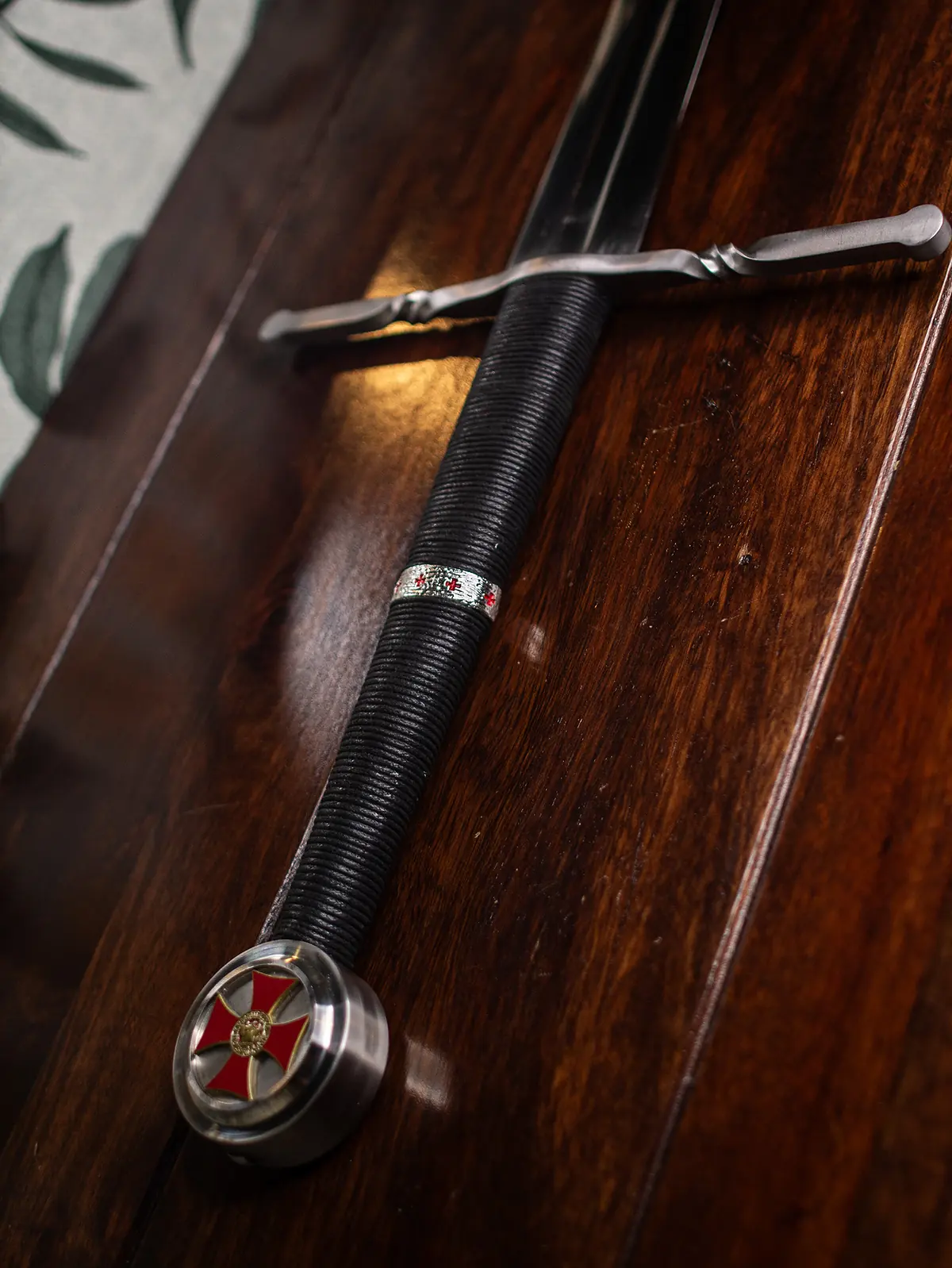
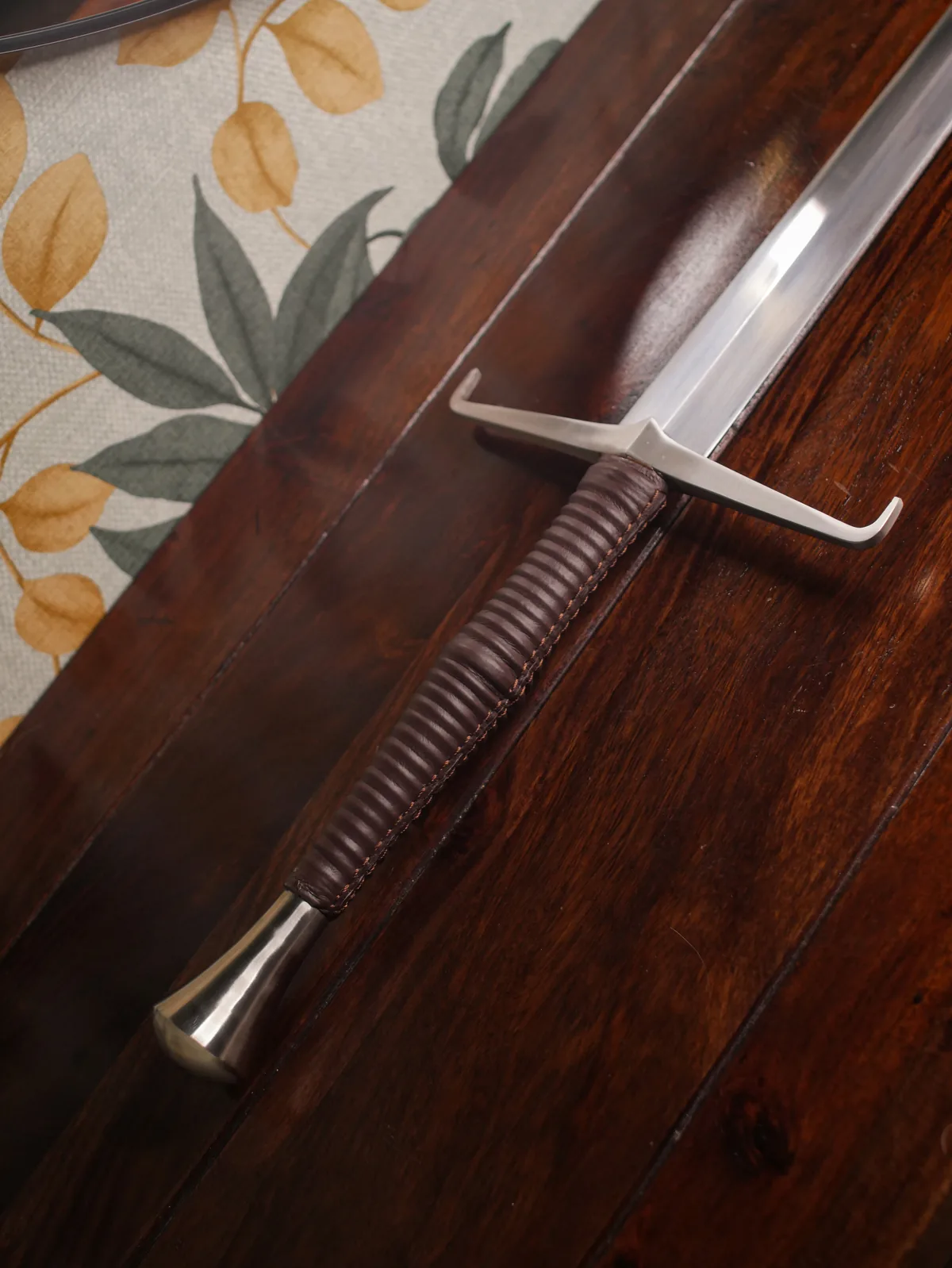
The counterweight to the blade: it moves the balance towards the hand, so the sword guides a cut instead of just swinging. On the Baldwin it is stainless steel and screws onto the tang — take it off and the sword comes apart for maintenance or a new grip wrap.
Screws onto the tang · removable for maintenance
Cord wrap
Grip
22.5 cm leaves room for both hands — the full longsword grip of the Liechtenauer treatises. The wrap is cord, with no leather: the hand does not slip on it, and it can be replaced once the pommel is off.
22.5 cm · room for two hands
Through the whole grip
Tang
The part of the blade you never see. It runs through the whole grip up to the pommel, which screws onto it, and it carries every impact from the edge to your hand. Only swords whose tang runs the full length of the grip make it into our offer.
The blade continues up to the pommel
Stainless steel · cross motif
Crossguard
The bar that protects the hand from a blade sliding down your own. On the Baldwin it is 21 cm wide and carries the same cross motif as the pommel. It is stainless steel, so unlike the blade it needs no oiling.
21 cm wide · stainless steel
9260 spring steel
Blade
9260 carries about two per cent silicon and is among the most forgiving grades used for swords: it survives bends that would leave carbon steel crooked for good. The declared 55–58 HRC is high for it, so the edge holds longer. It comes sharpened — for collections and cutting mats, not for sparring.
55–58 HRC declared by the maker · 4.5 cm at the guard · 7 mm · sharp
01 / 07
The armoury · Anno Domini
Steel thatremembersevery cut
Take the sword apart
9260 · FULL TANG
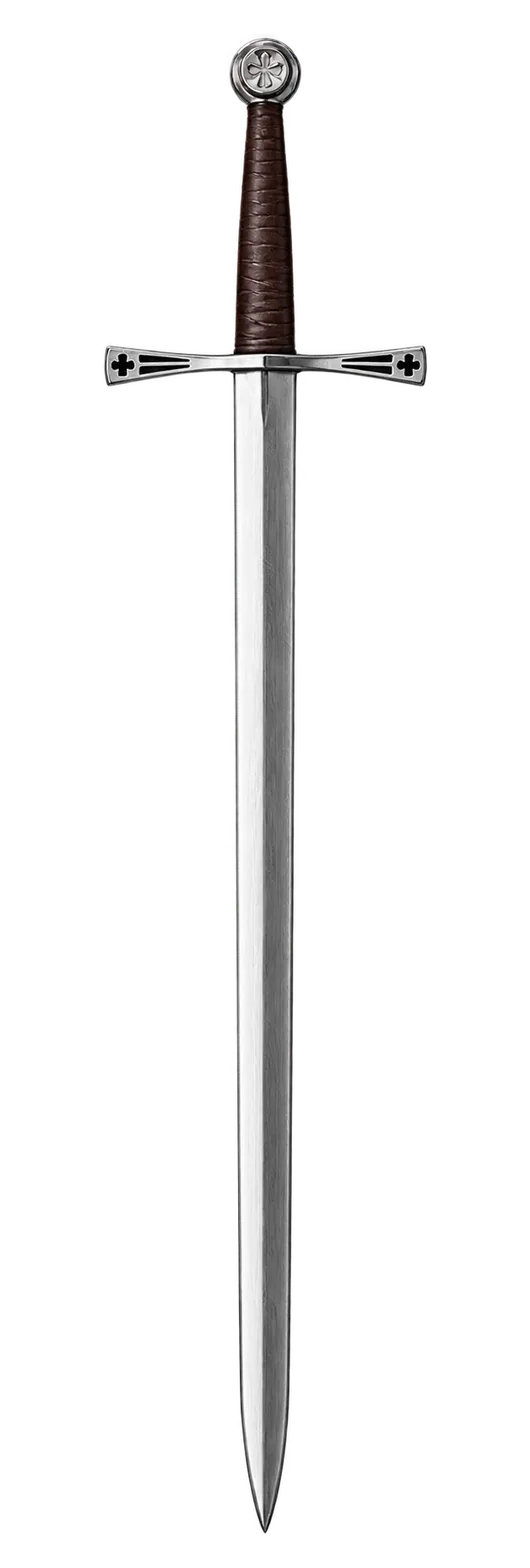
01Pommel
Stainless steel
screw-on
02Grip
Cord wrap
22.5 cm
03Tang
Through the whole grip
full tang
04Crossguard
Stainless steel
21 cm
05Blade
9260 spring steel
91 cm
Stainless steel · cross motif
Pommel
The counterweight to the blade: it moves the balance towards the hand, so the sword guides a cut instead of just swinging. On the Baldwin it is stainless steel and screws onto the tang — take it off and the sword comes apart for maintenance or a new grip wrap.
Screws onto the tang · removable for maintenance
Cord wrap
Grip
22.5 cm leaves room for both hands — the full longsword grip of the Liechtenauer treatises. The wrap is cord, with no leather: the hand does not slip on it, and it can be replaced once the pommel is off.
22.5 cm · room for two hands
Through the whole grip
Tang
The part of the blade you never see. It runs through the whole grip up to the pommel, which screws onto it, and it carries every impact from the edge to your hand. Only swords whose tang runs the full length of the grip make it into our offer.
The blade continues up to the pommel
Stainless steel · cross motif
Crossguard
The bar that protects the hand from a blade sliding down your own. On the Baldwin it is 21 cm wide and carries the same cross motif as the pommel. It is stainless steel, so unlike the blade it needs no oiling.
21 cm wide · stainless steel
9260 spring steel
Blade
9260 carries about two per cent silicon and is among the most forgiving grades used for swords: it survives bends that would leave carbon steel crooked for good. The declared 55–58 HRC is high for it, so the edge holds longer. It comes sharpened — for collections and cutting mats, not for sparring.
55–58 HRC declared by the maker · 4.5 cm at the guard · 7 mm · sharp
A handful of swords at a time, each one examined and measured before it ships. For collectors, reenactors and anyone who wants something real in their hands — full specifications, no marketing haze.
The split comes from the length of the grip, not the blade: an arming sword is used with a shield, a longsword lets you add a second hand, a two-hander demands both.
Zweihänder, spadone, montante15th–16th c. · Italian Wars and Landsknechts
Two-handers
A professional’s weapon: Doppelsöldner fought with it in the front rank and beside the colours. Parrying hooks and the ricasso let them grip the blade and work on a shorter lever.
Typical length135–170 cm
Typical mass2–3 kg
Balance (POB)12–18 cm
Blade sectionStiff diamond, ricasso with parrying hooks
We have no sword of this type in stock right now. Tell us what you are after and we will source it as an individual commission.
Sabres, falchions, messers14th–17th c. · from the falchion to the hussars
Curved and cleaving
Single-edged cutting blades. The falchion and the messer are medieval choppers; the sabre was the weapon of the Polish hussars and nobility, handled with fluid cuts from the wrist and elbow.
Typical length80–100 cm
Typical mass0.9–1.4 kg
Balance (POB)11–20 cm
Blade sectionSingle-edged, often with a false edge at the point
We have no sword of this type in stock right now. Tell us what you are after and we will source it as an individual commission.
The thrusting end of the blade. The later the type, the sharper its taper — an answer to plate armour, where fighters looked for gaps instead of cutting.
What it does
The tapering point concentrates the thrust on a small area.
02 / 07Lat. debilis
Weak of the blade
Cutting zone
The forward third. Fast, but without leverage in a bind — this is where cuts and thrusts land, not where you stop a blow.
What it does
This is where the blade moves fastest in a swing.
03 / 07
Fuller
Less mass
The long groove forged or ground into the blade. Not a blood groove — it takes mass from the centre of the section and leaves stiffness at the edges. The sword gets lighter, not weaker.
What it does
It removes metal where it adds little to stiffness.
04 / 07Lat. fortis
Strong of the blade
Binding and parrying
The part nearest the guard. Slow, but strongest in a bind — this is what takes a blow and pushes the other blade aside.
What it does
Closest to the hand, so it gives the most leverage in a bind.
05 / 07
Crossguard
Hand protection
The bar that protects the hand and lets you control an opponent's blade. Viking swords and Roman spathae already had a guard; what changed in the 11th century is that it grew into a cross — and the hand could finally work in front of the shield line.
What it does
It stops a blade sliding down yours towards the hand.
06 / 07Lat. manubrium
Grip
Grip
A wooden core over the tang, covered in leather and wrapped with cord or wire. Its length decides whether a sword is one-handed, a longsword or a two-hander.
What it does
The length of the grip tells you how many hands the sword takes.
07 / 07Lat. pomum
Pommel
Counterweight
The counterweight peened onto the end of the tang. It pulls the balance back towards the hand — without it even a light sword would drag forward.
What it does
It moves the centre of mass towards the hand.
Material
Not every steel deserves an edge
A medieval smith did not choose his alloy — he worked with whatever the bloomery gave him. Today the choice is deliberate: one steel for a sword that lives in a display case, another for one that takes a blunt blade to the head three times a minute.
The Polish chromium-vanadium spring steel, equivalent to 51CrV4 in EN 10089 — a standardised composition, available with a mill certificate. Chromium (~1%) lets even thicker sections harden right through, and vanadium (~0.15%) refines the grain: the blade copes well with impacts and repeated flexing, and the edge chips less. It gives a little ground to 9260 in resistance to bending, but hardens more evenly in thick sections.
9260
Silicon-manganese spring steel
52–56HRC
Around 2% silicon buys the springiness this grade is known for: it takes bends that would leave plain carbon steel crooked. The showroom “90° and back” is a seller's line rather than a measured standard — but in its class 9260 really is the most forgiving.
5160
Chromium spring steel
50–54HRC
Chromium added to a spring steel. The most widely used training-sword material in the world: the trade-off between hardness and impact resistance is about as good as it gets.
1060
Carbon steel
48–52HRC
Plain carbon steel with no alloying additions. Cheap to work, hardens well in oil, forgives small mistakes at the forge. It deforms permanently under serious contact — which makes it a steel for display pieces and light reenactment.
Which blades from games and film could actually be forged and carried, and which would wreck your wrist on the first cut? Mass, balance, geometry and steel — no legends.
The Witcher
The witcher's sword: the silver myth against metallurgy
Geralt carries steel for men and silver for monsters. In reality solid silver is too soft for a blade — 2.5 on the Mohs scale — and too heavy at 10.49 g/cm³ against steel's 7.85. A silver sword would bend on the first bone and lose its edge before it cut anything.
How it is actually done: a forged spring steel blade, silvered fittings, and runes etched into the fuller.
Geometry: Oakeshott type XVIIIb
The witcher sword's silhouette is a textbook late medieval hand-and-a-half. A grip of roughly 23 cm lets the second hand join without changing the hold, and the stiff diamond section at the point is exactly what the fifteenth century used to find the gaps in plate.
Daedric blades carry asymmetric spikes and hooks. On the first cut into a gambeson or a shield rim the hook catches and stays — and a weapon you cannot pull back out of the target is worse in a bind than no weapon at all.
Balance far ahead of the guard
No distal taper and a massive point push the balance roughly 30 cm past the guard. With that leverage, stopping a cut loads the wrist several times harder than a historical sword does, and in steel such a blade would weigh well over 5 kg.
The Lord of the Rings
Andúril and Glamdring: the benchmark smiths keep returning to
Forged from the shards of Narsil — Elendil's sword, whose broken blade Isildur used to cut the Ring from Sauron's hand — Andúril is routinely named the most historically sound sword in cinema. The design came out of Weta Workshop's art department and the blades were forged by Peter Lyon. The proportions match Oakeshott's hand-and-a-half types XIIa and XIIIa: a broad, evenly tapering blade, a long fuller, a grip for a hand and a half.
Mass: 1.45 kg · Balance: 8 cm from the guard
Glamdring — Foe-hammer
A leaf-shaped blade, widening around the percussion node — a solution known from Celtic swords and the Roman spatha. Broadening the blade there puts mass where it does the work in a cut, while a heavy pommel damps the vibration coming back into the hand.
Blade profile: leaf-shaped · Closest type: spatha / Oakeshott X
A dark, smoky tone, a rippling pattern, an edge that never dulls and a surprisingly low mass — George R.R. Martin's description of Valyrian steel reads like a description of wootz, the crucible damascus of India and Persia. The resemblance is deliberate, down to the secret of the melt being considered lost.
House Stark's “Ice” — a sword or an executioner's tool?
With a blade as wide as a palm and close to 170 cm long, Ned Stark's ancestral sword is the size of a two-handed bidenhänder, not an executioner's sword: those ran about 90–120 cm and ended blunt and rounded, because a beheading needs no point. As a weapon for the corridors of Winterfell it would be useless, but as a sword of justice carried before a feudal lord it is entirely in place.
Fantasy in the armoury
Want a sword that looks like the game and behaves like a weapon?
Tell us what sword you have in mind, or put a design together in the configurator: pick the blade type, the fuller, the fittings and the engraving, and we will price the commission with the maker and answer by email.
Legal note: this article is a weapons-history and cultural analysis published under the right of quotation (art. 29 of the Polish Copyright Act). The names of the universes and characters — The Witcher (CD PROJEKT S.A.), The Elder Scrolls V: Skyrim (ZeniMax / Bethesda), The Lord of the Rings (Middle-earth Enterprises), A Song of Ice and Fire and Game of Thrones (George R.R. Martin, HBO) — are cited for educational and comparative purposes only. Swords Vault sells historical swords and brokers individual commissions; we do not offer replicas of protected designs or trademarks.
Forging, normalising, oil quenching and tempering — the same bar of steel can come out a springy blade or a rod that snaps on the first blow. See what happens to the steel at each stage.
The bar heated to bright red. The smith draws out the taper and sets the fuller — mass first, shape second.
What happens to the steel
Austenite — plastic steel
At this heat the steel is austenite and moves under the hammer like hard wax. The hammer draws out the length and the taper of the blade.
900–1150 °C
At the forge
Orange heat · forging
Stage 02 / 05850 °C
Normalising
Several heating and cooling cycles even out the grain after forging and release the stresses that would later warp the blade.
What happens to the steel
Finer, even grain
Heating to the transformation point and cooling in air evens out the grain stretched by forging and relieves the stresses that would later warp the blade.
850 °C
At the forge
Cherry red · normalising
Stage 03 / 05780–830 °C
Hardening
The steel passes its transformation point. A violent quench turns austenite into martensite — hard, but brittle as glass.
What happens to the steel
Martensite — about 60 HRC
Fast cooling in oil traps the carbon in the iron lattice. The result is martensite: very hard but brittle as glass — in this state the blade could crack on impact.
780–830 °C
At the forge
Oil bath · quenching
Stage 04 / 05180–250 °C
Tempering
Controlled reheating gives the springiness back. This is the moment that decides whether a sword snaps or bends and returns.
What happens to the steel
Tempered martensite — usually 48–56 HRC
Reheating trades part of the hardness for resistance to cracking. After tempering the blade bends and returns instead of breaking.
180–250 °C
At the forge
Straw colour · tempering
Stage 05 / 05—
Grinding and assembly
Edge profiling, polishing, fitting the guard and grip, peening the pommel over the tang. Last of all — the scabbard.
What happens to the steel
Edge and fittings
Grinding gives the edge its profile. Then the guard, the grip and the pommel on the tang — peened or screwed on — and finally the scabbard.
—
At the forge
Cold steel · grinding
Care
You buy a sword once, you look after it monthly
Spring and carbon steel — what serious swords are made of — rusts. That is not a defect but the price of the hardness and springiness stainless cannot give. All of maintenance comes down to three things: keep it dry, keep a thin film of oil on it, keep it out of the scabbard.
The range is small on purpose — we source single pieces against specific orders. Send us a type, a period or a photograph of what you have in mind and we will tell you within 1 business day whether it can be had, and for how much.