Bestseller13th-century styling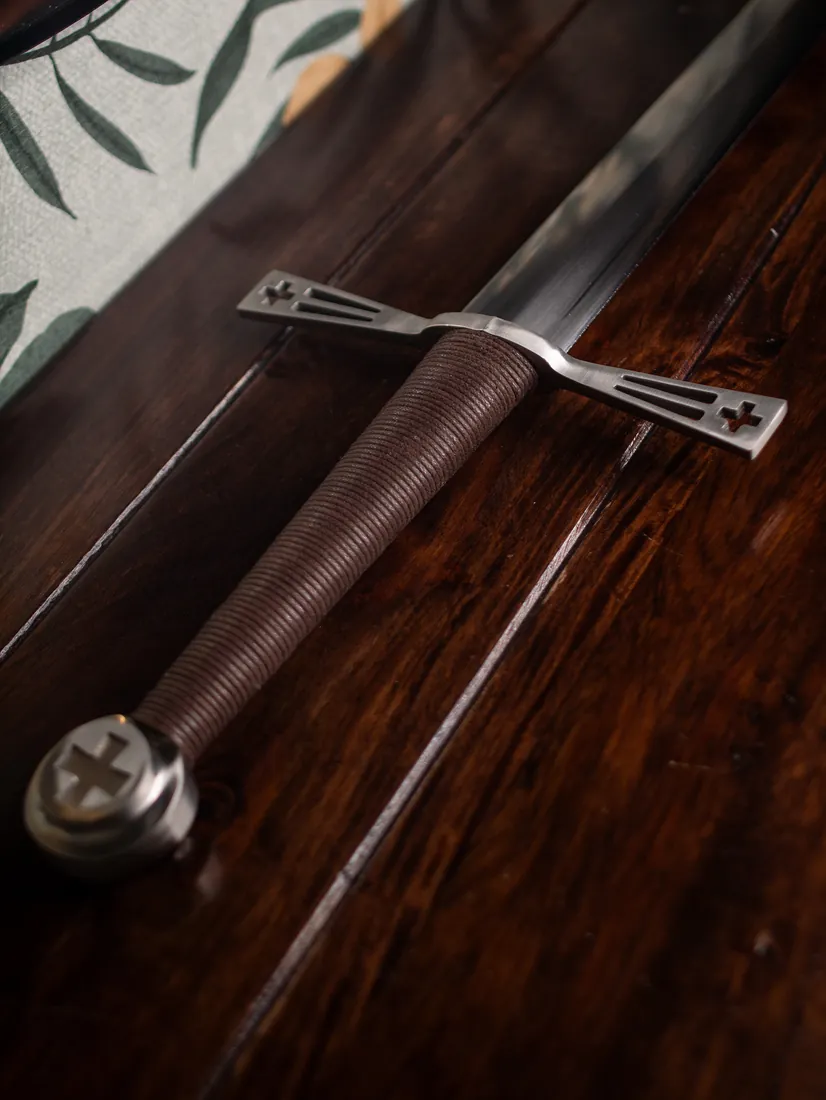
Templar Longsword “Baldwin”
Hand-and-a-half sword, sharp 9260 blade, scabbard included
- Steel
- 9260
PLN 1,900
NewShips within 2 working days
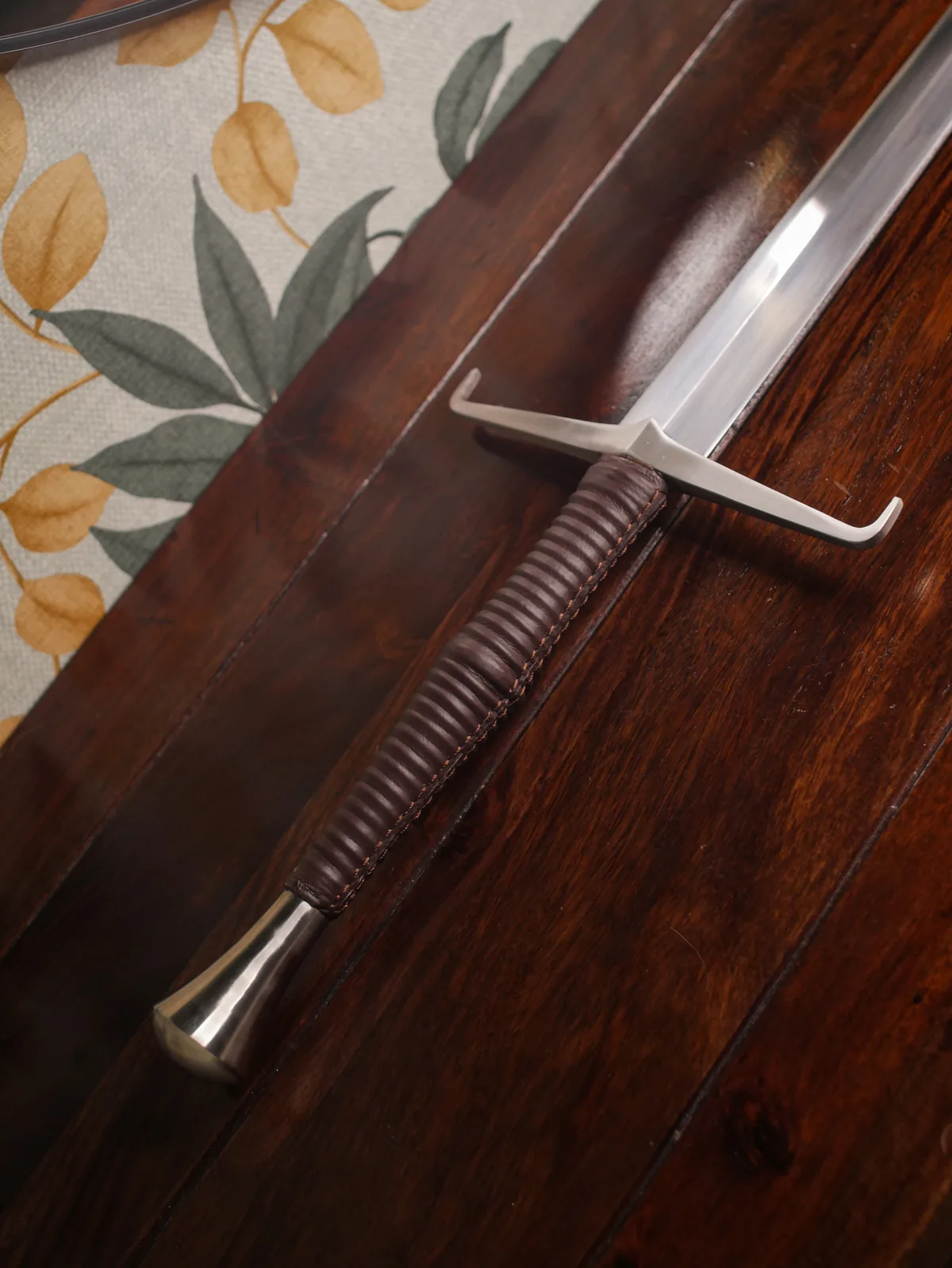
Owijka rękojeści i głowica widziane z boku
Hand-and-a-half sword, sharp 1060 blade, scabbard included
A full-size bastard sword: a factory-sharpened 1060 carbon steel blade, a slender guard sweeping toward the blade and hooked at the tips, and a scabbard with a suspension rig in the set.
VAT included · shipping from 0 PLN
Only 2 left
A bastard sword is not a type of its own so much as a sword between categories: too long to work comfortably in one hand, too short for a full two-handed lever. Hence the name — a weapon of mixed parentage, neither one thing nor the other. Here that comes out as 91 cm of blade and a 22 cm grip: the second hand has somewhere to sit, and the first still steers.
1060 steel is roughly six tenths of a per cent carbon — the classic blade material, cheap to work and easy to sharpen. The stated 55–58 HRC is typical for it after tempering and means an edge that holds for a long time. What 1060 does not have is the springiness of a silicon steel like 9260: bend it hard and it stays bent. This is a sword for the display case and for cutting mats, not gear that forgives mistakes.
Let us be honest about the weight — 1.85 kg is a lot. Period originals with a blade this long usually ran 1.2–1.6 kg, because a fuller and a pronounced distal taper took mass out of them. Here there is no fuller at all, and the blade starts at 7 mm thick by the guard and 4.5 cm wide — all that steel has to go somewhere. In the hand it reads as a heavy, “pulling” sword that cuts with mass rather than speed. Anyone after a nimble longsword for fencing should know that before buying.
The furniture is a modern designer’s idea, not a reconstruction. The slender guard sweeping down toward the blade with hooked, upturned tips, and the flared cone of a pommel, are shapes you will not find in surviving 15th-century material — they look superb, and that is exactly how to take them. The blade itself sits closer to history: broad, flat, fuller-less, with clear bevels at the edges and a gentle taper. In Oakeshott’s typology it lands nearest to type XVIIIa.
Guard and pommel are stainless steel and need no oil; the blade does, because 1060 rusts without mercy. The grip wrap and the scabbard are synthetic leather — not hide, and it behaves accordingly: it will not take oil and will not break in over the years. The tang runs the whole length of the grip (full tang) and the pommel is threaded, so the sword comes apart for maintenance.
Note: this piece comes with a factory-sharpened edge, meant for collecting and for cutting practice on mats. It is not suitable for sparring with a partner — contact calls for blunt gear with an edge at least 2 mm thick and a rounded tip.
From the same rack